

The number of people, who purchase “tinted lenses” for some purposes not only for the season with strong sunlight but also for the fashion or night driving, have been increasing.
However, when you choose tinted lenses, you may come across some words such as “density” and “luminous transmittance”, and various numbers. This can make you feel confused and ask yourself, “What should I use as a basis for choosing?”.
Especially when you intend to use tinted lenses for night driving, choosing the wrong ones can be dangerous.
In this article, we will explain “luminous transmittance” which you should know when choosing tinted lenses.
【Table of Contents】
- What Is Luminous Transmittance?
1.1 Luminous transmittance that is considered human-perceived “brightness”
1.2 Why is “luminous” included in the word, “luminous transmittance?”
1.3 The comparison of lens color and how things look - The Difference between “Luminous Transmittance” and “Visible Light Transmittance”
2.1 Visible light transmittance = The physical amount of light
2.2 Luminous transmittance = How human eyes perceive
2.3 Which is more important for night driving? - The Difference between “Luminous Transmittance” and “Density
3.1 The difference between the percentage of light “transmitted” and the percentage of light “blocked
3.2 “Density” is a subjective expression
3.3 “Luminous transmittance”, which can be judged numerically - Check “Luminous Transmittance” When Choosing Tinted Lenses
1. What Is Luminous Transmittance?
1.1 Luminous transmittance that accounts for perceived “brightness” by the human eye.
Let us start with the conclusion, luminous transmittance is a quantified measure of “how bright the light appears to the human eye when it passes through a lens.”
It is expressed as 0% when no light passes through, and 100% when all light passes through.
1.2 Why is “luminous” included in the word, “luminous transmittance?”
In fact, our eyes have different sensitivity to brightness depending on the color (wavelength of light).
For example, even when the light has the same intensity, we tend to perceive yellow and green as brighter, while blue and red tend to look dimmer to our eyes.
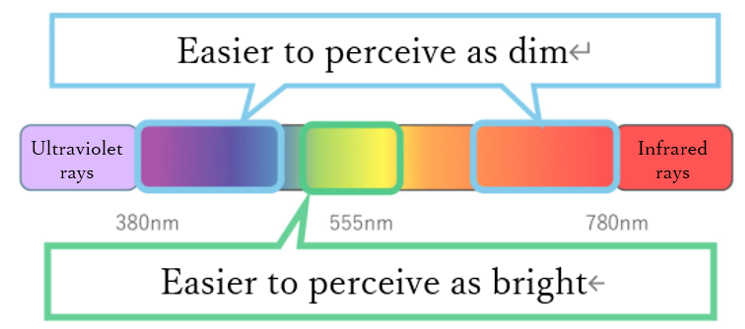
Since the transmittance is based on how humans uniquely perceive brightness, it is called “luminous” transmittance.
By looking at this value, you can tell “how bright the light is actually perceived”, not just the amount of light.
1.3 The comparison of lens color and how things look
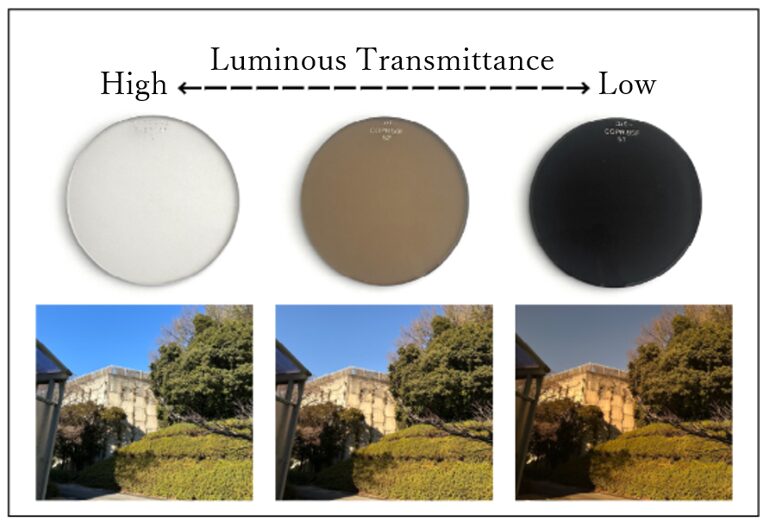
Depending on the difference in luminous transmittance, there are some differences in lens color and how things look as follows.
- A higher value (close to 100%): Lens color is light, things look bright
- A lower value (close to 0%): Lens color is dark, things look dim
2. The Difference between “Luminous Transmittance” and “Visible Light Transmittance”
There is a similar word, “visible light transmittance.”
“Visible light” literally refers to the wavelength range (approximately 380 nm 780 nm) that the human eye perceives as light and can distinguish as color.
“Luminous transmittance” and “visible light transmittance” differ in whether they are based on “human perception” or on “mechanical measurement.”
2.1 Visible light transmittance = The physical amount of light
Visible light transmittance is a value obtained by physically measuring the amount of light that passes through the lens.
Regardless of the type of light (color), it is the data exactly as measured by the device.
2.2 Luminous transmittance = How human eyes perceive
Luminous transmittance is an adjusted value based on visible light transmittance, focusing on “colors that appear brighter to the human eye.”
This value is calculated not only by “the amount of light”, but by focusing on how much of the light that appears brighter to human eye, such as yellow or green, passes through the lens, making it closer to how you actually see.
2.3 Which is more important for night driving?
The answer is “Luminous transmittance.”
Since the way our eyes perceive brightness is directly linked to safety, the value of luminous transmittance, which represents the brightness as it is actually perceived by the human eye, is used as the safety standards.
3. The Difference between “Luminous Transmittance” and “Density”
When you purchase tinted lenses at the eyeglasses store, you may be explained like “the density of this lens is 25%.”
The density is almost the same as the number of 100 minus luminous transmittance.
For example, when luminous transmittance is 75%, the density would be 100%-75%=25%.
※Please note that the actual value may slightly vary depending on the color, so this value is only an approximation.
3.1 The difference between the percentage of light “transmitted” and the percentage of light “blocked”
- Luminous transmittance: The value of “how much light passes through the lens”
(luminous transmittance85% = transmits 85% of light) - Density: The value of “how much the lens blocks light”
(density15% = blocks 15% of light)
3.2 “Density” is a subjective expression
“Density” is easy to understand, but it does not have a clear definition.
The meaning of the value is not standardized, so the expression differs depending on companies.
It is like a “product name” used as a guideline when you choose tinted lenses.
3.3 “Luminous transmittance”, which can be determined numerically
On the other hand, luminous transmittance is a “public standard that indicates how much brightness can be perceived by human eyes”, so it has an advantage of allowing a more accurate judgement of whether something is too dark.
4. Check “Luminous Transmittance” When Choosing Tinted Lenses
The term “luminous transmittance” may sound a bit technical, but it refers to “the proportion of brightness that reaches our eyes.”
Please note that when choosing tinted lenses, you should check the standards-based indicator, “luminous transmittance” not only visual “density.”
Please do not forget to check luminous transmittance for your safety, especially when driving at night.
If you are not sure, please feel free to consult an optician.
We would be glad if this article helped you to find suitable tinted lenses for your use cases.
 Categories
 Tags
Tags