

More people have started to be mindful of UV protection not only in the summer, but throughout the year. Did you know that ultraviolet rays reach not only your skin, but your eyes?
As the amount of ultraviolet rays has been increasing, we have received more inquiries, such as “what should I do for UV protection?” and “Are sunglasses or UV-blocking lenses really effective?”.
In this article, we will introduce how to protect your eyes from ultraviolet rays for those who want to know “the UV protection you can do on your own.”
What Is Ultraviolet Ray?
Sunlight includes “visible light” which can be seen with our eyes and invisible light such as ultraviolet rays and infrared rays.
You may think “glare = ultraviolet rays”, but the major cause of glare is visible light.
※Visible light refers to the light that can be seen by human eye, with wavelengths range from 380 nm to 780 nm.
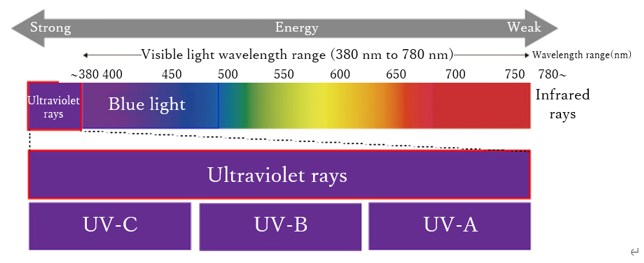
On the other hand, ultraviolet rays are invisible, but they have a short wavelength and high energy.
- UV-A: Ultraviolet rays that are easy to reach the ground throughout the year. It darkens the skin.
- UV-B: It has high energy and increases in summer. It can cause skin inflammation.
※UV-C does not reach the ground as blocked by the ozone layer.
✅A helpful tip
“Just because something is invisible does not mean it has no effect.”
We are exposed to ultraviolet rays without realizing it. That is why daily care is important.
Three stories that we should know about ultraviolet rays
Ultraviolet rays are invisible, but their effects on the eyes and body have been revealed through years of research.
We will introduce 3 things that we want many people to know.
1) The relationship between ultraviolet rays and eye inflammation/diseases
Ultraviolet rays can reach from the surface of the eyes to its inside, and their effects on eye inflammation, the crystalline lens, and the conjunctiva have been reported.
Below are some typical examples known to be related to ultraviolet rays.
- Eye inflammation that occurs after exposure to strong ultraviolet rays
- Cataract that is related to exposure to ultraviolet rays for a long time
- Pterygium, which is affected by high levels of outdoor ultraviolet rays’ exposure
These are thought to be associated with not only aging, but also with an environment where you are exposed to ultraviolet rays and with your lifestyle habits.
✅A helpful tip
The effects of ultraviolet rays accumulate little by little.
That is why it is important to always be mindful of ultraviolet rays.
2) It is said that we are exposed to large amounts of ultraviolet rays during our growing years
Some studies have reported that we receive most of ultraviolet rays we are exposed to in our lifetime by around the age of 18.
Children are in an environment where they are more easily affected by ultraviolet rays because
- They spend a long time outdoors
- They are shorter in height and more easily exposed to sunlight reflected from the ground
That is why UV protection from early childhood has been getting attention as one of the lifestyle habits that looks ahead to the future.
✅A helpful tip
What matters is “how easy it is to keep doing.”
Wearing glasses, sunglasses, and hats with UV-blocking features is effective.
3) Can ultraviolet rays that enter through the eyes affect the skin?
Although it is not widely known, studies have confirmed that ultraviolet rays entering through the eyes can affect the skin through reactions within the body.
It has been demonstrated that ultraviolet stimulation, which enters through the eyes, is delivered to the brain and triggers changes in hormone secretion that cause the skin to darken.
Thus, UV protection should not be considered “only for the skin,” as it is also “important to think about protecting the eyes.”
✅A helpful tip
Wearing sunglasses or UV-blocking lenses is one of the daily UV protection cares, not only for fashion.
UV protection for your eyes that is easy to adopt daily
1) Choose the lens with UV-blocking feature
Currently, many eyeglass lenses come with UV-blocking features.
On the other hand, store-bought sunglasses sometimes vary in performance.
When you purchase them, you should choose the ones with a UV 400 label.
✅A helpful tip
Even if the lenses are clear or lightly tinted, they can still block ultraviolet rays.
Just because the lenses are clear does not mean they let ultraviolet rays pass through.
2) Those who are concerned about glare should pay attention to “the quality of light”
Not only ultraviolet rays but also certain types of visible light can cause glare.
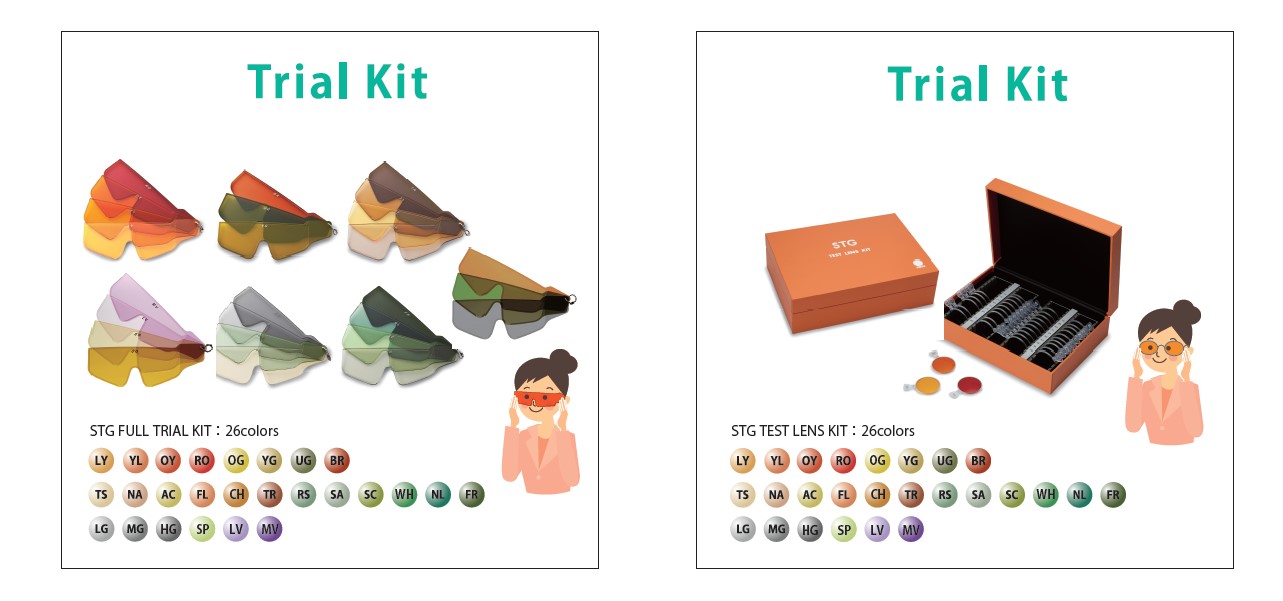
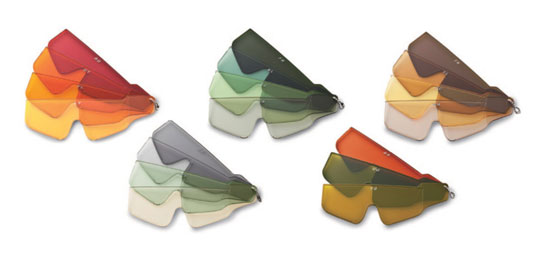
Absorptive lens is designed to block the light in a specific wavelength range effectively, so it is chosen by those who want to “maintain the visibility without making it too dark.”
※There are individual differences in how things look or how they perceive.
✅A helpful tip
Choose based on “comfort”, not “darkness.”
This is the key to selecting lenses that are easy to use every day.
Absorptive Lens
3) Provide subtle UV protection for your child’s eyes
Children who play actively outdoors are exposed to more ultraviolet rays than adults.
Along with caps or sunshades, let’s use lenses with UV protection.
As clear lenses can also block ultraviolet rays, they are easy to use for everyday wear.
※TOKAI’s plastic lenses come with UV protection as a standard feature.
✅A helpful tip
“Not special protection”, but “your everyday glasses.”
What matters is whether you can keep it up without pushing yourself too hard.
Summary | Start with what you can and protect your eyes from ultraviolet rays
Since ultraviolet rays are invisible, you may tend to ignore them, but you can protect your eyes with small daily habits. Especially when you are outdoors, your eyes are exposed to not only ultraviolet rays but also to other types of light that can cause strain.
- Choose UV-blocking lenses or the lenses that block blue light with high energy
- Reassess your lenses if you feel glare
- Especially care for children’s eyes
Even if you have not thought about it before, why don’t you take this opportunity to make UV protection for your eyes part of your everyday life?

 Categories
 Tags
Tags